 Keepable
Reach a person by their NIN
Address an employment letter, statement or contract using the NIN you already hold. The recipient’s Keepable account is connected to their verified identity. Email is another way to match a personal account.
Send a letter, statement or contract to the Keepable connected to a person’s NIN or a company’s CAC number. Use the identity detail you already hold.
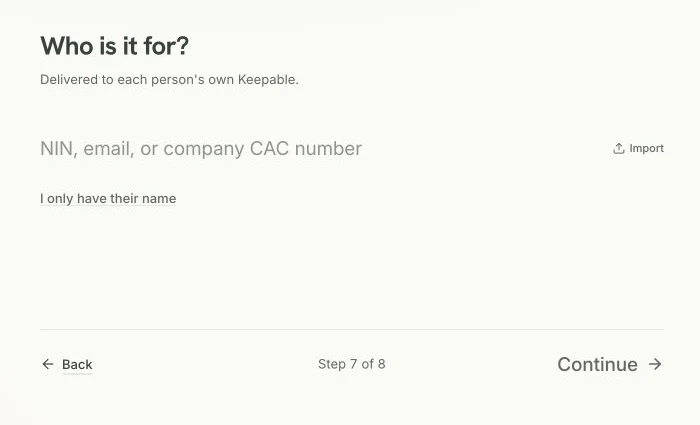
Address an employment letter, statement or contract using the NIN you already hold. The recipient’s Keepable account is connected to their verified identity. Email is another way to match a personal account.
Send a contract or letter to the company’s own Keepable mailbox. Its CAC number identifies the organisation, while authorised mailbox members handle the received correspondence.
If a person has not joined, issue a claim code and give it to them through a channel you already use. They join and claim with a verified name matching the one you supplied. Keepable does not deliver the code for you.
People join with a NIN check and liveness verification.
Address an active organisation mailbox by CAC number; access belongs to authorised members.
Undeliverable recipients are refunded when the send closes.
Twelve characters in three groups behind a KPC prefix, drawn from a 27-symbol alphabet with every confusable character removed: no O against 0, no I or L against 1, no U against V. That is about 57 bits, from the system's cryptographic random source, derived from nothing about the person. It is meant to be read off a screen and typed somewhere else.
The code on its own does not open anything. Whoever redeems it has to be NIN-verified, and their verified name has to agree with the name you declared. Every word you wrote must appear in the NIMC record, so Okafor alone will not redeem a code you issued for Chukwuemeka Okafor, while Chukwuemeka Nnamdi Okafor will. It runs one way only: their record may carry names you never knew, you cannot introduce one it lacks.
It absorbs the six ordinary ones: word order, a middle name on one side only, case, punctuation, missing diacritics, and a given name shortened by dropping its leading particle, so Babatunde matches Tunde and Oluwaseun matches Seun. That last tolerance applies only when the surname already matches exactly. There is no edit distance and no phonetics, so a genuine misspelling fails. Void it and reissue.
It stays live until it is redeemed, until you void it, or until the file's own expiry passes, whichever comes first. Voiding clears the value from the record, so a database dump never carries a live secret for a deposit that is already closed. Reissuing mints a fresh one.
You do, over whatever channel already reaches them: the SMS you were going to send anyway, WhatsApp, the branch counter, the foot of an invoice. Keepable does not deliver it. You pull the whole set as a CSV carrying the code, the declared name, your own reference and the state of each one, and re-join it to your records.
A recipient that fails validation is rejected on its own at the moment you send, carrying the position in your list and your reference for that person, and the rest of the batch goes. One mistyped row in a payroll file does not stop ten thousand payslips.
An email address matches a person, it does not hold a place for one, so an address nobody has claimed is not yet a mailbox. And Keepable cannot reach somebody who has never opened one. That is what the claim code is for: you hand it over the way you already reach that customer, and it opens their Keepable at your document.